On 20 August, the community GGUF repository for Qwen3.8-27B, maintained by Unsloth, showed 4.3 million downloads on its last-30-days counter on Hugging Face. The official repository, published by the Qwen team themselves on 5 August with an eight-day head start, showed about one million on the same counter, read the same day.
The most-downloaded version of one of the year's most talked-about open models is not the official one. It's the version people rebuilt to run on their own hardware.
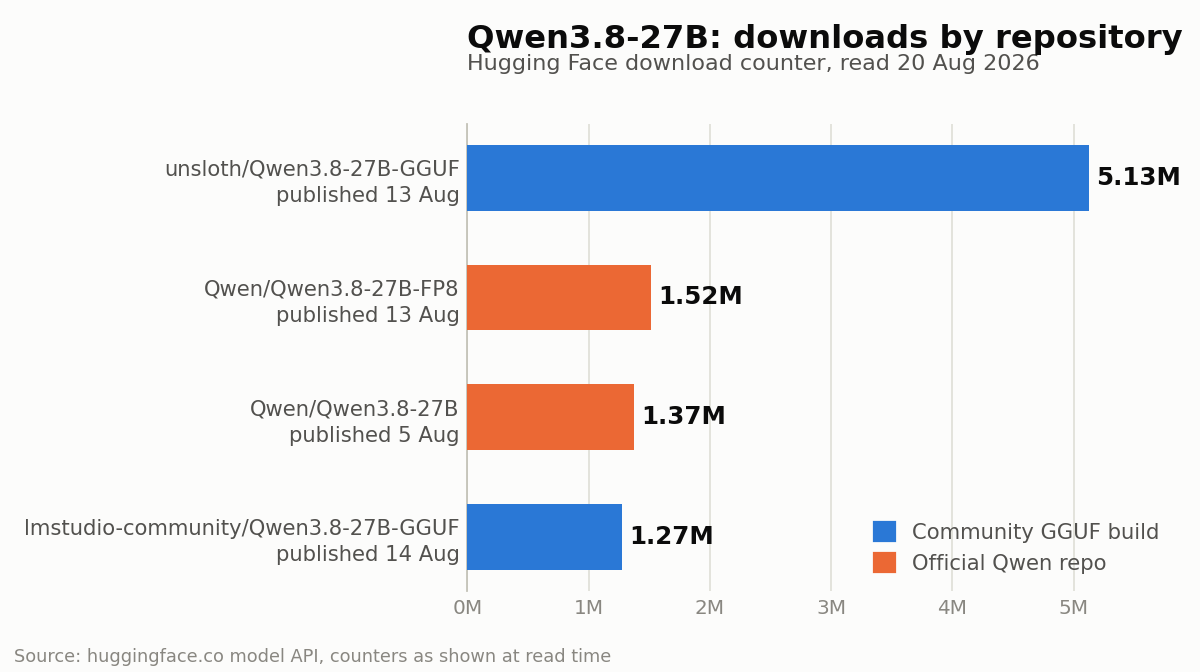
What a community build is, and why it wins
The official release ships the model as raw full-precision weights: hundreds of gigabytes, in a format built for research clusters. Before it runs on hardware normal organisations own, someone has to convert it to GGUF, the format the llama.cpp engine serves, and quantise it, compressing the weights so the model fits in real memory.
That work is done by community groups, Unsloth most prominently among them, usually within hours of a release. Their builds are not knock-offs; their quantisation recipes selectively keep the quality-sensitive layers at higher precision, and the download numbers say the community trusts the results. The GGUF repository is where the model stops being a research artefact and becomes something you can run.
The wider sweep
The two-repository comparison understates it. Our script queries the Hugging Face API for every repository carrying this model and sums their last-30-days counters. At the 20 August reading: 14.4 million downloads across the ecosystem, of which 12.3 million, about 85%, are community builds rather than the official weights. Hundreds of community variants exist: different quantisation levels, different fine-tunes, different trade-offs of size against quality.
The standing honesty note, same as our spot reports: downloads are not users. A CI pipeline can pull a model daily, mirrors count, one team can account for hundreds of downloads. We make no claim about how many people this represents. But the comparison holds, because every repository is read by the same instrument on the same day, and on that identical measure the community builds outdraw the official weights several times over.
The news is not the benchmark
On public benchmarks, Qwen3.8-27B beats Claude Opus 4.6 on some tests and loses on others. That is not the news. Frontier labs and open labs have been trading benchmark wins for two years, and the leaderboard will look different next quarter.
The news is distribution. Fourteen million downloads in a month, five in six of them builds designed for self-hosting, is the market answering a different question: not "which model is cleverest?" but "where do I want the model to live?" And the answer, at volume, is: on hardware I control.
Why people choose the harder path
Running your own model is more work than calling an API. Millions of downloads say people are doing that work anyway, and the reasons are not mysterious.
A model file on your own disk answers to nobody. There is no kill switch: it cannot be deprecated, retired, or withdrawn behind you. There is no logging: prompts never leave your machines, which for a regulated firm is the entire conversation. There is no tagging: outputs are yours, unmarked by any vendor. And there is no per-seat meter running in the background as your team grows.
None of that shows up on a benchmark. All of it shows up in a download counter.
Where we fit
Qwen3.8-27B went into our appliance catalogue the week it trended. That's the appliance's design working as intended: newly measured models publish to our catalogue and pull onto a box you already deployed, no rebuild, no new image, and only when you ask. The appliance runs entirely inside your own Azure tenant, nothing leaves your subscription, and deploy to first answer takes about five minutes, model download included. We timed it.
If you want the model everyone is downloading, running privately on infrastructure you control, it's on the Azure Marketplace, with a one-click deploy and the model menu guide.
Receipts: all download figures are Hugging Face last-30-days counters, read 20 August 2026 by our sweep script, which queries the Hugging Face API for every repository carrying the model and sums their counters; the chart above is from the same run. The official repository's 5 August publish date is taken from its Hugging Face page. Downloads are not users; see the honesty note above. Benchmark comparisons referenced without numbers are from the model card's published results.