On 11 September we pulled 13 of the most popular open models from Hugging Face onto one Azure VM, straight into memory. 2.25 TB landed in about three minutes. The download peaked at 174.6 Gbit/s and averaged 104.
Twenty minutes later we pulled the same 13 models again. Same VM, same network, same tools. It ran at 43 Gbit/s and stayed there.
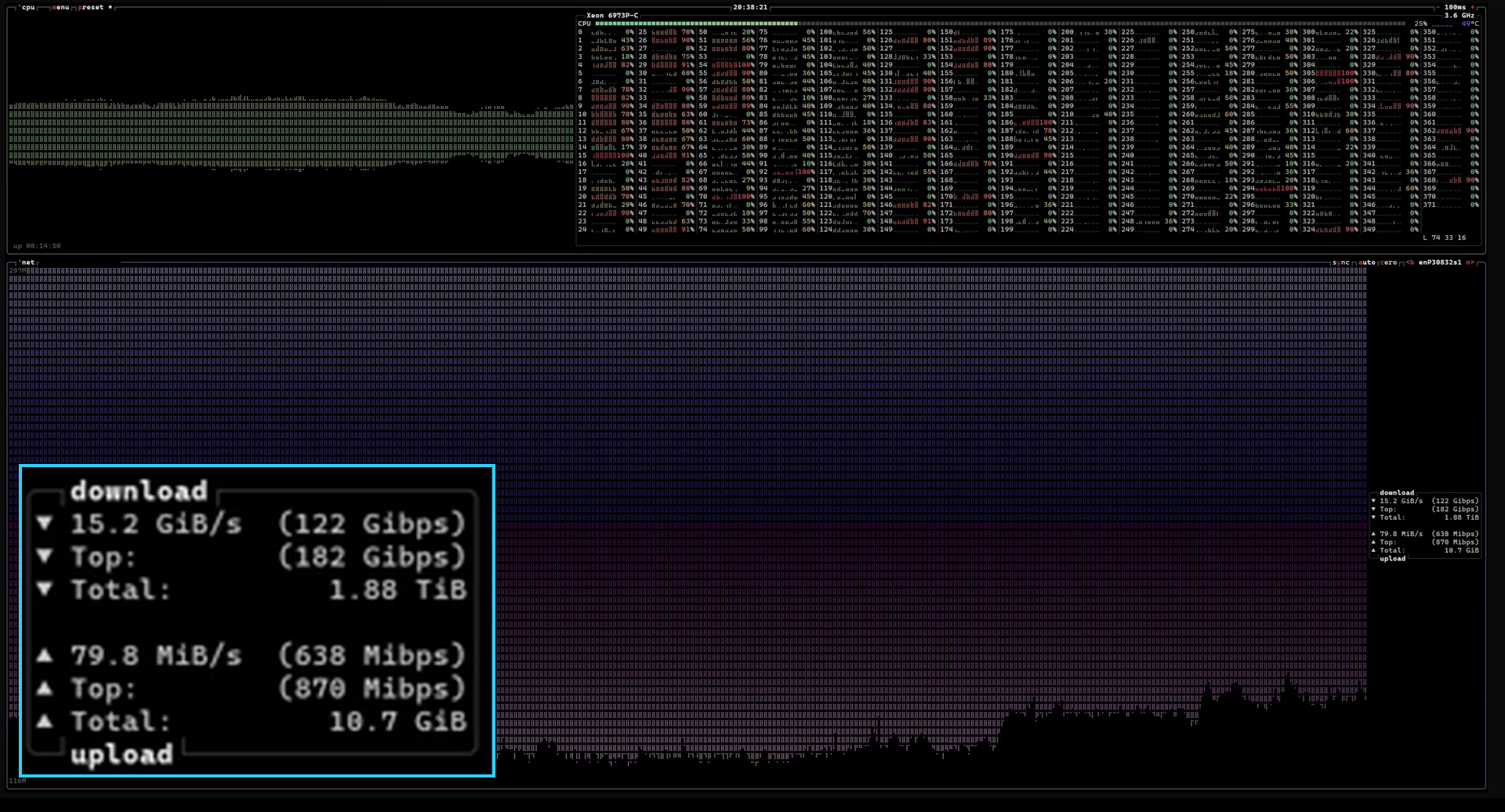
Click to play. The video runs from the first run's peak into the drop. Azure E372is_v7, East US, 11 Sep 2026.
The three runs
| Run (11 Sep 2026) | What we pulled | Result |
|---|---|---|
| 1, 20:36 | 13 popular models | Peak 174.6 Gbit/s, average 104, 2,254 GB in about 3 minutes |
| 2, 20:48 | 17 large, less popular models | About 44 Gbit/s, flat |
| 3, 20:56 | The same 13 models as run 1 | About 43 Gbit/s, flat |
A single pull later that evening managed 20.3 Gbit/s.
Why we think the limit was on their side
Run 3 is the one that matters. It used the same models, the same VM and the same number of parallel downloads as run 1, twenty minutes later, and it was four times slower than the peak. So it wasn't the choice of models and it wasn't our setup.
In run 1 the speed followed the number of downloads running almost exactly. 174 Gbit/s with 8 running, 85 with 3, 55 with 2. It never levelled off, so we never found where our network ran out.
Runs 2 and 3 were the opposite, a flat line that didn't move whatever we did. That's what a rate limit looks like, not what a busy network looks like. Our best guess is that pulling about 2.25 TB in three minutes from one address put us in a different bucket. We haven't seen this documented at this scale, so treat it as what we measured on one day from one VM, not as Hugging Face's policy.
To be fair to them, it's a free service and we were hammering it.
What the VM is rated for
The E372is_v7 is the biggest VM in Azure's Ev7 memory range, and it's rated at 400 Gbit/s of network. Nothing else in the range comes close.
| Size | Rated network |
|---|---|
| E192s_v7 | 100 Gbit/s |
| E248s_v7 | 150 Gbit/s |
| E372is_v7 | 400 Gbit/s |
Our 174.6 is 44% of that rating, measured over the public internet against a third party. So it tells you the network card did at least 174.6, not that it tops out there. Proving the 400 needs two of these VMs talking to each other on a private network, which is next on our list once we have the capacity.
What it means if you're staging models
- Don't plan around the first download. The speed you get on a fresh pull isn't the speed you'll get once you're a heavy user. Every pull figure we've published before was a light-usage number.
- Keep your own copy close to where it runs. For one model, re-downloading is fine. For terabytes, or for rebuilding several machines, a copy in your own storage in the same region is faster and more predictable.
- 43 Gbit/s is still quick. At that speed a 100 GB model arrives in about 20 seconds. The drop matters for staging a library, not for a single model.
So what would fill a 400 Gbit/s pipe?
We used less than half of it, and the limit still wasn't ours. Another VM in the same network, or Azure storage spread across several accounts, are the obvious candidates.
Method
- VM: Azure E372is_v7 (Spot), East US, 11 September 2026. 2,787 GB of RAM, no local temporary disk.
- Downloads: 8 parallel pulls with the Hugging Face tools, written straight into a 2,300 GB RAM disk (tmpfs) so no disk was in the path. The Hugging Face download cache was also kept on the RAM disk.
- Measurement: the network interface's received-byte counter, sampled every 2 seconds. btop in the video shows a higher peak (182) because it samples every 100 ms and reports in binary units, so we quote the 2-second figure.
- Rated figures: Azure's published network bandwidth for the Ev7 sizes, as of 12 September 2026.
- One VM, one evening. We haven't repeated it on another day or from another region.