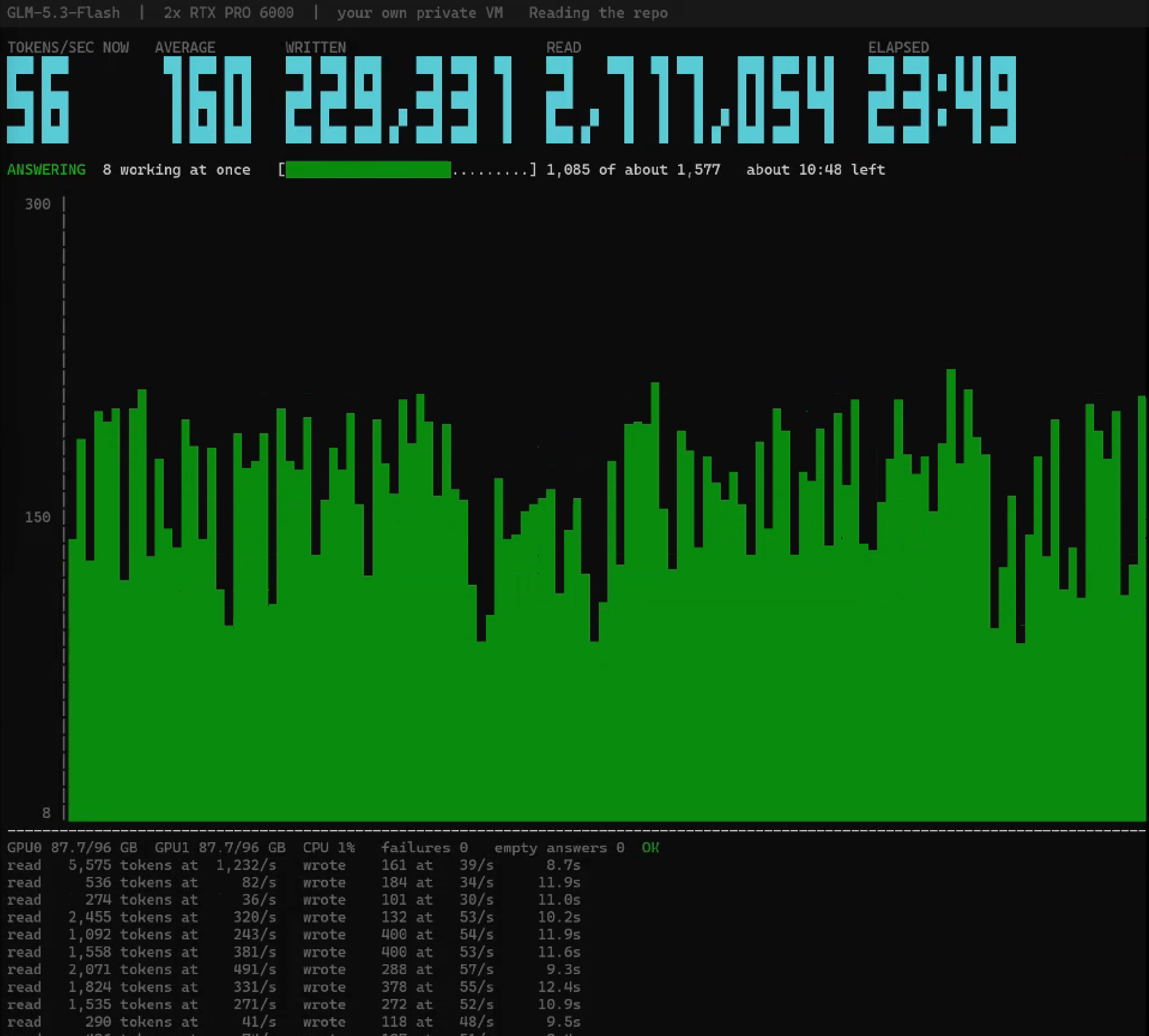
The live screen during the run, about 24 minutes into the reading stage. The graph is total tokens a second. The server was working on 4 requests at a time, with 4 more queued, which the screen counts as 8 working at once.
The short version
Point an open model at a real codebase and ask it to explain the architecture. We did exactly that on a single Azure VM with two RTX PRO 6000 GPUs:
| Code | About 580,000 lines: about 284,000 of code, the rest JSON, docs and config |
| Files read | 1,336 |
| Tokens read | 4.67 million |
| Tokens written | 638,000 |
| Time | 57.5 minutes |
| Failed requests | 0 |
| Diagrams | 468 of 479 drew first time |
| Compute cost | About $2 of spot compute, East US |
The person who knows the code checked a sample of the diagrams, and those were right. The code stayed on the VM. The value is the combination of reliability and fixed compute cost on private code.
At launch, Artificial Analysis had GLM-5.3-Flash level with Claude Opus 4.8 on its Intelligence Index v4.1.1, as reported here. On the newer v5 index, it scores 28, against a 23 median for open models of similar size. The point is different: there's a lot of code and data that companies have never been allowed to put through AI at all. For that work, a good model you control beats a brilliant one you can't use.
The job
We ran the same two-step job as in August, on the same private repo:
- Read every file. Each one gets a short summary, split into parts if it's large.
- Draw the architecture. Working upwards from those summaries, the model writes a description and a diagram for every folder, ending with the whole repo.
The model does all the reading itself. It sees only its own summaries when it builds the tree.
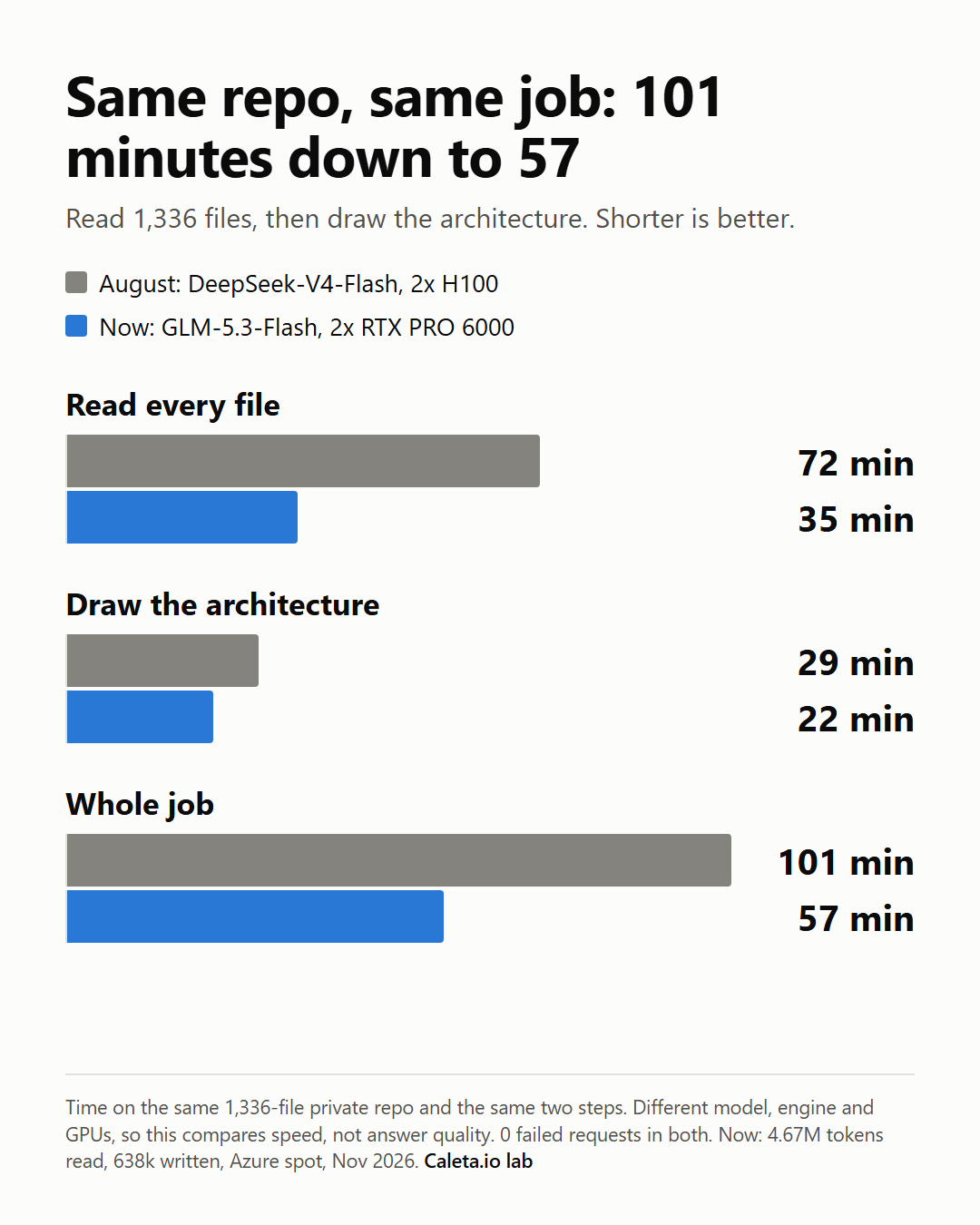
| Stage | August: DeepSeek-V4-Flash, 2x H100 | Now: GLM-5.3-Flash, 2x RTX PRO 6000 |
|---|---|---|
| Read every file | 72.2 min | 35.2 min |
| Draw the architecture | 29.2 min | 22.3 min |
| Whole job | 101.4 min | 57.5 min |
| Tokens written | 397k | 638k |
| Failed requests | 0 | 0 |
This compares speed, not quality. The model, engine and GPUs all changed, and GLM simply wrote more. Of 479 diagrams, 10 had a syntax error and 1 was cut off at our token limit. Of the 1,577 summaries, 80 hit our 400-token cap and were cut short.
Why it got so much faster
The biggest change wasn't the hardware. It was the engine.
We first ran this model on llama.cpp, which is what most people start with. It works, and we got it to double its out-of-the-box speed with careful tuning. Then we tried TensorFold, a newer engine with kernels written for a short list of models.
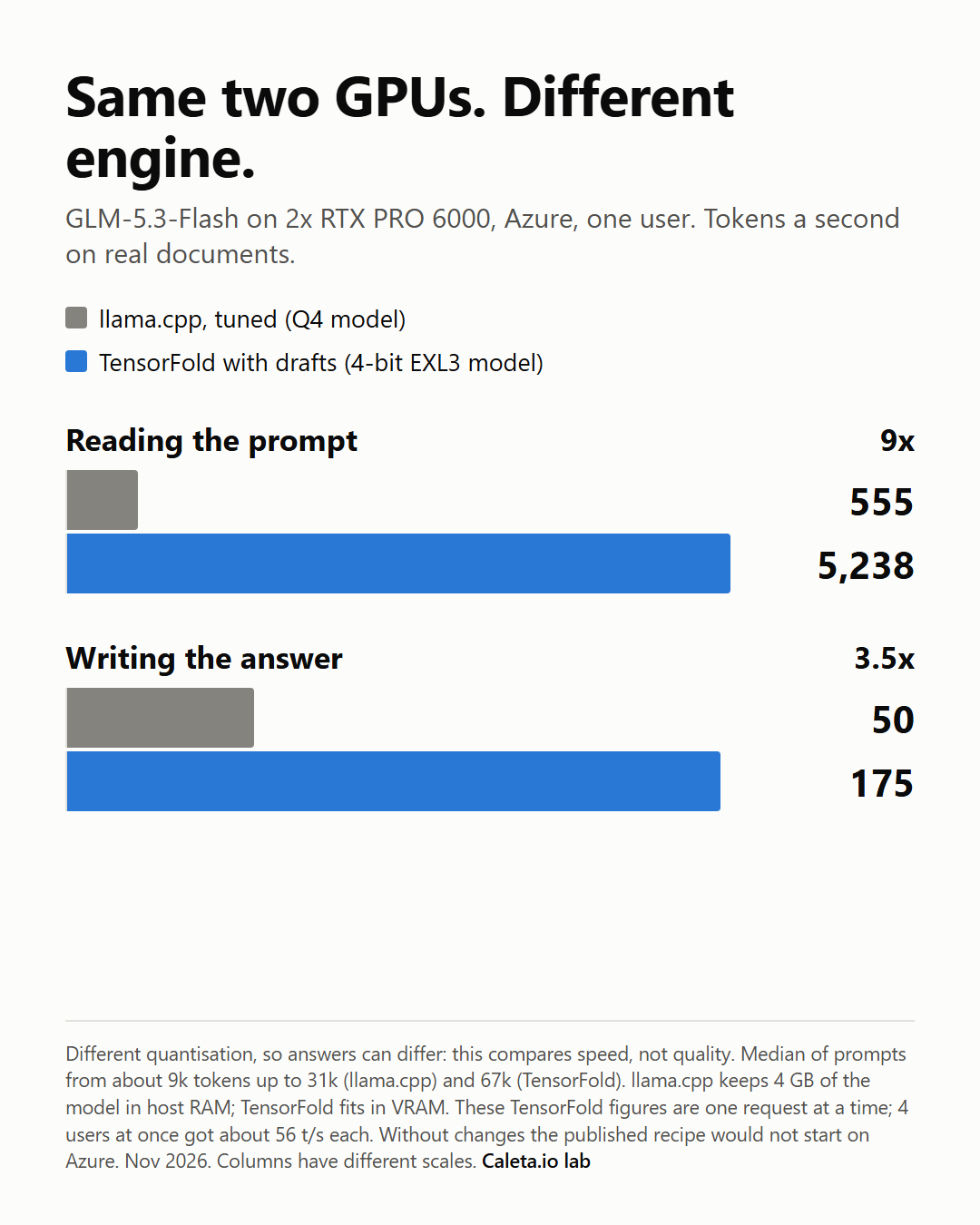
| Same two GPUs, real documents, one user | llama.cpp, tuned | TensorFold with drafts |
|---|---|---|
| Reading | 555 tokens/s | 5,238 tokens/s |
| Writing | 50 tokens/s | 175 tokens/s |
| A 67,000-token prompt read in | About 2.6 minutes | 13 seconds |
The llama.cpp 67,000-token time is from its deeper-context setup, which reads a little slower than the figure above. The speeds use the same documents, but llama.cpp's come from the server's own timings and TensorFold's from time to first token.
Three things seem to account for it:
- Both cards work at once. With llama.cpp's layer split, each card holds different layers, and they largely take turns. TensorFold splits each layer across both cards.
- Kernels built for the model, rather than general-purpose code.
- Drafts. It predicts a few tokens ahead and checks them. On our hard test problem, drafting nearly doubled the speed and gave an identical answer.
There are trade-offs. It uses a smaller 4-bit build of the model, and it runs a short list of models rather than nearly anything. llama.cpp's reach is still why it's most people's starting point.
The Azure catch
Published results for this recipe reach about 245 tokens a second on the same cards. It wouldn't even start for us at first.
On Azure, these GPUs are presented as virtual GPUs, and the two cards can't reach each other directly. NVIDIA's own tool reports the path as fine, while CUDA reports it as unavailable. The recipe relies on that path. We got it running by sending that traffic through host memory instead, which took several configuration changes.
We also left out the fastest draft model, because its licence is non-commercial. So our 175 isn't directly comparable with the published 245, and it isn't a failure of the recipe. It's what we measured on Azure, with parts a business can use.
How many users?
You choose:
| Mode | Speed |
|---|---|
| One request at a time, with drafts | About 175 tokens/s |
| Up to 4 at once, no drafts | About 56 tokens/s each, 223 in total |
The repo job used the second mode, with 4 running at once, and averaged 159 tokens/s writing summaries and 226 drawing the architecture.
What it costs
At about $2.03 an hour for East US spot, the whole job cost about $1.94 in compute.
Be careful with that number. It's cheap because the VM ran only for the job. Left on all month, it's about $1,480. Hosted APIs serving open models can also be cheaper per job, and they cost nothing when idle. If you don't need the privacy and control, a hosted API may well be the better choice.
The limits, plainly
- One repo, one reader. One person checked a sample of these results, and we haven't run a formal quality comparison.
- 4-bit build. This is a lower-fidelity build of the model. On one hard test problem it got the right answer, with one arithmetic slip in its reasoning.
- Spot can be taken back. Running across more than one region reduces the risk of eviction stopping the work, if you need it up all the time, but it costs more and we haven't tested it here.
- Not long-run tested. Our longest run was about an hour.
- Prompt reuse wasn't working for us. Each turn re-read the conversation, which is fine for this job but would slow an agent.
- It's not in our appliance. This is a separate, hand-built setup. Our Marketplace appliance runs llama.cpp, and doesn't offer this.
- Private means inference. The model ran on the VM, with no API. We still downloaded the model and cloned the repo over the internet, and we didn't block outbound traffic for this test.
Credit
This builds on TensorFold and the Aevonix recipe, in collaboration with Mia's AI Lab. GLM-5.3-Flash is MIT-licensed.
Want this on your own Azure?
If you have code or documents you've never been allowed to put through AI, we can get this running privately in your own subscription, and tell you honestly whether it's the right fit. Get in touch.